• Home
  • Bank of Subjects of Articles
    • Bibliography
    • Characters
    • Culture and art
    • Economics
    • Educational sciences
    • ethics
    • Geography of Islamic world
    • History
    • Islamic jurisprudence and principles
    • Kalam (Islamic scholastic theology)
    • Mahdism
    • Philosophy and logic
    • Political science
    • pray and pilgrimage
    • Prophet and Ahl-al bayt
  • Islamic Teachings
  • quran
  • The Infallibles
  • Shia Beliefs
  • Morality
  • Events
    • Media Reflection
    • Muharram
    • News of Shia World
    • News of Worldly Assembly for Shia Studies
  • Home
  • Bank of Subjects of Articles
    • Bibliography
    • Characters
    • Culture and art
    • Economics
    • Educational sciences
    • ethics
    • Geography of Islamic world
    • History
    • Islamic jurisprudence and principles
    • Kalam (Islamic scholastic theology)
    • Mahdism
    • Philosophy and logic
    • Political science
    • pray and pilgrimage
    • Prophet and Ahl-al bayt
  • Islamic Teachings
  • quran
  • The Infallibles
  • Shia Beliefs
  • Morality
  • Events
    • Media Reflection
    • Muharram
    • News of Shia World
    • News of Worldly Assembly for Shia Studies
Home Bank of Subjects of Articles Culture and art

Nakhl-Gardani, A Symbolic Funeral Procession for Imam Hussein (AS)

by mustafa askari
2022-08-17
in Culture and art
0
Nakhl-Gardani, A Symbolic Funeral Procession for Imam Hussein (AS)
0
SHARES
139
VIEWS
Share on FacebookShare on Twitter
 Nakhl-Gardani is one of the mourning rituals held in different parts of Iran in the month of Muharram which symbolizes the funeral procession of Imam Hussein (AS).


Muharram, the first month of lunar calendar, is the period of recalling and mourning the martyrdom of Imam Hussein (AS) by Shia Muslims communities.

Imam Hussein (AS), his family and his loyal companions, who were deprived of water for three days were eventually martyred by the army of Yazid I at the Battle of Karbala on Yazid’s orders on Muharram 10, known as the Day of Ashura. Ashura literally means the Tenth in Arabic.

Shia Muslims usually begin mourning from the first night of Muharram and continue for ten nights.

Various mourning ceremonies are performed during Muharram in different parts of Iran. Nakhl-Gardani is the one that certainly stands out.

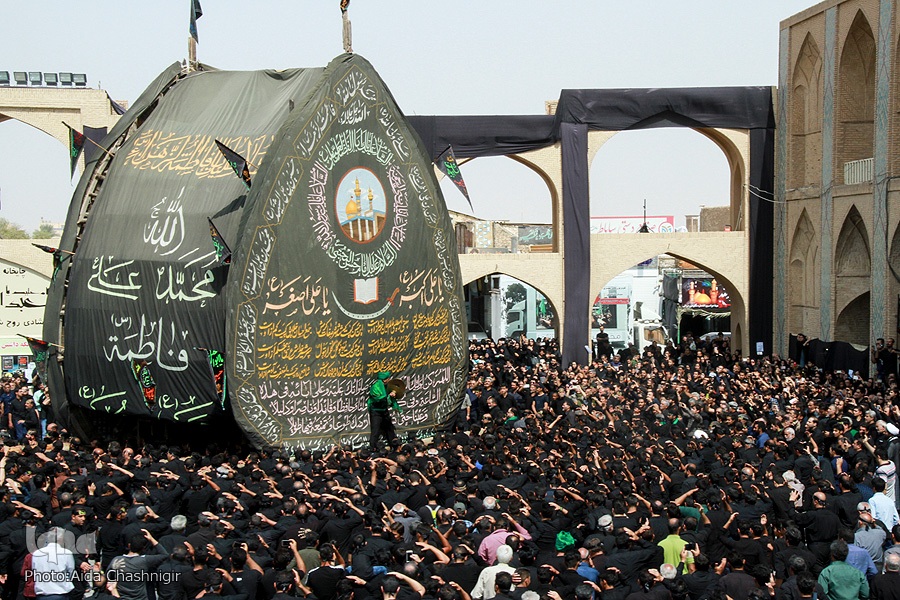
Nakhl means palm tree in Persian language. It is a symbol of the coffin (casket) of Imam Hussein (AS), which is used during his symbolic procession ceremony.

Nakhl is a wooden structure shaped like a tree leaf. Nakhl, which resembles a chamber with a gabled roof, is covered mainly with black cloth.

Some days prior to the ceremony the Nakhl is decorated with small and large mirrors, knots and silk clothes tied at its sides. Mourners also decorate the symbolic coffin with myrtus leaves and other plants and flowers, photo frames of local martyrs, and colorful shawls.

The ceremony starts on the morning of Ashura when crowds of mourners set off for Hosayniyas (places used for religious mourning ceremonies) with the eulogists narrate the Ashura event and the life story of Imam Hussein (AS) and his companions.

Mourners, who are usually dressed in shades of black, beat on their chests according to the rhythm of a sung eulogy.

The procession walks, mourning and lamenting, a few kilometers to the Hosayniya. When they arrive at the Hosayniya the ceremony reaches its peak. As they enter the heart of the large crowd, they suddenly accelerate while approaching the Nakhl.

Nakhl is a hefty and massive structure; therefore mourners lift and carry it in big groups.

Crowd of mourners go under the Nakhl and lift it, along with those who had already settled there, all beating their chests with great weeping and wailing. They then walk around Hosayniya while carrying the Nakhl three or five times and finally put it back in its place.

Free drinks and food stuff (called Nazri in Persian language) will be distributed among the mourners as well.

The skeletons of Nakhls are usually kept in Hosayniya and mosques throughout the year.

The ceremony is registered on the intangible cultural heritage list of the country. In recent years, various organizations have made arrangements for the presence of foreign tourists in this event.

Nakhl-Gardani, A Symbolic Funeral Procession for Imam Hussein (AS)

Origin of Nakhl-Gardani

There are various narrations to explain the reason behind naming the ceremony as such. The most probable one is that in the Karbala incident branches of palm tree were used to carry the body of Imam Hussein (AS).

The exact origins of this ritual are not known, but it is very likely that this method of mourning dates back to the Safavid era and the formalization of the Shia Islam in Iran.

While the ceremony is performed in Semnan, Damghan, Qom, Kashan, Abyaneh, Khor-Biabanak, Zavareh, Ardestan, Naeen and generally, cities and towns in the desert areas of Iran, the most conspicuous Nakhl-Gardani ceremonies are held across Yazd province on the Day of Ashura.

Yazd, the cradle of Zoroastrianism, is now one of the unavoidable points of Islamic Iran. The city is home to thousands of small and big mosques and Hosayniyas. It has earned the title “Iran’s and world’s Hosayniya”.

Observing such rituals and performing mourning ceremonies to commemorate Imam Hussein (AS) gather flock of people together reminding Muslim Unity. The gatherings also help narratives of the Battle of Karbala survive for the generations to come.

source:iqna

Tags: AllahAshuraImam Husain
Previous Post

Why Aren’t All People Guided by Quran’s Verses?

Next Post

Over 6m People Visited Karbala on Ashura: Official

mustafa askari

Related Posts

Ayat Peyman, Secretary-General of the World Assembly of Shiite Studies: “America’s Prestige Has Crumbled Around the World”   vista.ir
Article Database

Ayat Peyman, Secretary-General of the World Assembly of Shiite Studies: “America’s Prestige Has Crumbled Around the World” vista.ir

by mehdi mollayi
2026-10-18
The Supreme Leader’s Message on the Occasion of the Birth Anniversary of Lady Zaynab (peace be upon her) and Nurses’ Day Nurses: Reviving Life and Inspiring Hope in Society
Article Database

The Supreme Leader’s Message on the Occasion of the Birth Anniversary of Lady Zaynab (peace be upon her) and Nurses’ Day Nurses: Reviving Life and Inspiring Hope in Society

by mehdi mollayi
2026-10-18
Al-Sahifa al-Sajjadiyya: The Psalms of the Household of Prophet Muhammad (PBUH)
Article Database

Al-Sahifa al-Sajjadiyya: The Psalms of the Household of Prophet Muhammad (PBUH)

by mehdi mollayi
2026-10-13
An Introduction to Shi‘a Studies: A Review of the Book
Article Database

An Introduction to Shi‘a Studies: A Review of the Book

by mehdi mollayi
2026-10-10
I Want to Support the Shia School of Thought
Article Database

I Want to Support the Shia School of Thought

by mehdi mollayi
2026-10-01
Next Post
Over 6m People Visited Karbala on Ashura: Official

Over 6m People Visited Karbala on Ashura: Official

Leave a Reply Cancel reply

Your email address will not be published. Required fields are marked *

Latest Post

Ayat Peyman, Secretary-General of the World Assembly of Shiite Studies: “America’s Prestige Has Crumbled Around the World”   vista.ir

Ayat Peyman, Secretary-General of the World Assembly of Shiite Studies: “America’s Prestige Has Crumbled Around the World” vista.ir

2026-10-18
The Supreme Leader’s Message on the Occasion of the Birth Anniversary of Lady Zaynab (peace be upon her) and Nurses’ Day Nurses: Reviving Life and Inspiring Hope in Society

The Supreme Leader’s Message on the Occasion of the Birth Anniversary of Lady Zaynab (peace be upon her) and Nurses’ Day Nurses: Reviving Life and Inspiring Hope in Society

2026-10-18
Al-Sahifa al-Sajjadiyya: The Psalms of the Household of Prophet Muhammad (PBUH)

Al-Sahifa al-Sajjadiyya: The Psalms of the Household of Prophet Muhammad (PBUH)

2026-10-13
An Introduction to Shi‘a Studies: A Review of the Book

An Introduction to Shi‘a Studies: A Review of the Book

2026-10-10
The Imam: A Revealed Truth from the Unseen Realm

The Imam: A Revealed Truth from the Unseen Realm

2026-10-04
I Want to Support the Shia School of Thought

I Want to Support the Shia School of Thought

2026-10-01
Load More

Browse by Tags

Ahl al-Bayt (A.S.) Ahlul Bayt Al-Mahdi (AS) Allah Ashura Ayatollah Sobhani Ethics faith Fatima fiqh ghadir God History Holy Prophet Imam 'Ali Imam Ali (A.S.) Imam Husain Imams infallibles Islam Islamic Laws Islamic rules Jurisprudence Karbala Martyrdom morality Muhammad Nahj al Balaghah prayer prophet Quran Ramadan Reborn Salat Sayed Moustafa Qazwini shaistudies shia Shia Beliefs Shia Imams Shia Islam Shia Studie's World Assembly shiastudies Sin the differences between Shi’a and Sunni the story of those who converted to Shia Islam

The World Assembly of Shiite Studies was established in 2003 (1382 AH) by a group of scholars from seminaries and universities. The purpose of founding this independent academic institution was to introduce the school of Shi‘ism and defend its legitimacy through education, research, translation and publication, communications, and Islamic promotion. This center has continued its mission with strength and determination and envisions a bright future ahead.

Address: Qom, 45-Meter Ammar Yaser Boulevard, between Alley 4 and 6, World Assembly of Shiite Studies, Secretariat of Religious Scholars

Phone: +982537713773

Fax: +982537713774

All rights of the website are reserved and belong to the World Assembly of Shiite Studies.