The Incident of Fadak: From the Prophet Muhammad’s Gift to Lady Fatimah al-Zahra (PBUH) to the Assertion of Her Rightful Ownership
Introduction
The incident of Fadak is one of the most significant and controversial events in early Islamic history. It has long attracted the attention of researchers, historians, and Islamic scholars, particularly scholars of the Imamiyyah school of thought. This event was not merely a dispute over ownership of an agricultural estate and its revenue; rather, it involved deeper theological and historical dimensions directly connected to the questions of Imamate, caliphate, and the status of the Ahl al-Bayt (the Prophet’s Household).
A comprehensive examination of this event requires studying its historical, Qur’anic, and hadith-related dimensions and considering the accounts recorded in Muslim historical and hadith sources.
Why Is the Incident of Fadak Particularly Important?
The special attention given to issues concerning Lady Fatimah al-Zahra (peace be upon her), particularly the incident of Fadak, stems from two important considerations.
1. The Spiritual and Religious Status of Lady Fatimah al-Zahra (PBUH)
Lady Fatimah al-Zahra (peace be upon her) holds an exceptionally distinguished position in Islamic sources. According to the Shi’a perspective, her infallibility is established through Qur’anic verses and narrations from the Prophet Muhammad (peace and blessings be upon him and his family).
Therefore, examining her conduct, positions, and statements concerning major events in early Islamic history is of particular significance.
2. The Connection Between Fadak and the Questions of Imamate and Caliphate
The issue of Fadak extends beyond the ownership of a particular piece of land. Its examination raises important questions concerning the qualifications of an Imam, the justice of an Islamic ruler, the protection of individual rights, and the treatment of the Prophet’s Household.
From this perspective, the significance of Fadak lies not merely in its economic value but also in the theological and historical consequences of the incident. These issues have been debated and examined by scholars throughout Islamic history.
The Connection Between the Incident of Fadak and the Question of Imamate
One of the most important dimensions of the Fadak incident is its connection to the question of Imamate and succession following the passing of the Prophet Muhammad (peace and blessings be upon him and his family).
To understand this connection, it is necessary to consider the discussions raised by Muslim theologians and scholars regarding the qualifications of an Imam and the methods by which Imamate can be established.
Sharif al-Jurjani’s View on the Proof of Imamate
In his book Sharh al-Mawaqif, Sharif al-Jurjani discusses the question of Imamate. He explains that, according to the Sunni perspective, Abu Bakr was the rightful Imam after the Prophet Muhammad (peace and blessings be upon him and his family), whereas the Shi’a consider Imam Ali ibn Abi Talib (peace be upon him) to have been the rightful Imam.
He identifies two principal arguments for establishing the legitimacy of an Imam:
- An explicit designation (Nass) by Allah or the Prophet Muhammad (peace and blessings be upon him and his family).
- The consensus of Muslims and their agreement through allegiance (Bay’ah).
Sharif al-Jurjani states that there was no explicit prophetic designation establishing Abu Bakr’s Imamate, and that the principal argument advanced in support of his caliphate was the consensus of the Muslim community. [1]
This statement is significant because it demonstrates that discussions concerning the basis for establishing Abu Bakr’s caliphate also appear in Sunni theological literature.
The Qualifications and Characteristics of an Imam According to Sunni Scholars
In another section of Sharh al-Mawaqif, Sharif al-Jurjani discusses the qualifications and characteristics required of an Imam.
According to his account, an Imam should possess several important qualities, including:
- Knowledge and the ability to exercise independent legal reasoning (Ijtihad) in matters of religious principles and secondary rulings.
- The ability to present arguments and respond to theological objections.
- Courage and the capacity to defend the Muslim community.
- Justice and avoidance of oppression against others.
- Sound judgment and the ability to administer the affairs of society.
- Adulthood and the necessary qualifications to assume leadership responsibilities.
He identifies these qualities as relevant requirements for Imamate. [2]
From the Shi’a perspective, these criteria are important when evaluating the conduct of rulers after the Prophet’s passing. If justice and competence are essential qualifications of an Imam, then a ruler’s conduct in matters such as Fadak must also be examined in light of these principles.
How Did Fadak Become the Property of the Prophet Muhammad (PBUH)?
To examine Lady Fatimah’s claim of ownership over Fadak, it is first necessary to establish the historical and legal status of this land.
Fadak was an estate in the Hijaz region that came under the control of the Prophet Muhammad (peace and blessings be upon him and his family) without a military battle or armed confrontation.
In Islamic jurisprudence, property acquired by the Prophet without military engagement was classified as Fay’, a category of property governed by specific Islamic legal provisions. [3]
Reference to Verse 6 of Surah al-Hashr
The Holy Qur’an states regarding the property of Fay’:
وَما أَفاءَ اللَّهُ عَلىٰ رَسولِهِ مِنهُم فَما أَوجَفتُم عَلَيهِ مِن خَيلٍ وَلا رِكابٍ وَلٰكِنَّ اللَّهَ يُسَلِّطُ رُسُلَهُ عَلىٰ مَن يَشاءُ وَاللَّهُ عَلىٰ كُلِّ شَيءٍ قَديرٌ
Translation:
“And whatever Allah restored to His Messenger from them, you did not spur for it any horses or camels; rather, Allah gives His messengers authority over whom He wills, and Allah is over all things competent.”
(Surah al-Hashr, 59:6)
This verse provides an important foundation for understanding the Islamic legal provisions governing Fay’ property.
Al-Qurtubi’s View on Fay’ Property
In his Qur’anic commentary Al-Jami’ li-Ahkam al-Qur’an, al-Qurtubi explains, while interpreting verse 6 of Surah al-Hashr, that the property of Banu al-Nadir was among the assets that came under the Prophet’s control without a major military campaign.
He notes that the Muslims had not undertaken a military expedition or endured the hardships of battle to acquire this property. Accordingly, it was placed under the authority of the Prophet, who administered it according to the interests of the Islamic community. [3]
A similar account is narrated from Umar ibn al-Khattab in Sahih Muslim. He explains that the property of Banu al-Nadir was among the assets Allah had granted to His Messenger, for which the Muslims had not advanced with horses or camels. This narration is significant for understanding the legal status of Fay’ property. [3]
Fadak: A Land That Came Under the Prophet’s Control Without a Battle
One of the important historical sources concerning the status of Fadak is Al-Tafsir al-Kabir, written by Fakhr al-Din al-Razi.
While interpreting verse 6 of Surah al-Hashr, al-Razi raises the question of whether the property of Banu al-Nadir was acquired without military confrontation or whether its acquisition followed a siege and military engagement.
He presents two different views in response.
According to one of these views, the verse in question was revealed concerning Fadak, because its inhabitants reached a peaceful agreement with the Prophet Muhammad (peace and blessings be upon him and his family) without engaging in battle and subsequently handed over their land.
Fakhr al-Razi writes:
“Perhaps this verse was revealed concerning Fadak, because its inhabitants abandoned their land, and their property came into the possession of the Messenger of Allah (PBUH) without war or fighting.” [4]
This account is significant because it identifies Fadak as an example of property acquired by the Prophet without military confrontation.
Yaqut al-Hamawi’s Account of the History of Fadak
In his book Mu’jam al-Buldan, Yaqut al-Hamawi discusses the geographical location and historical background of Fadak.
He describes Fadak as a village in the Hijaz region, approximately two or three days’ journey from Medina. According to his account, the land came under the Prophet’s control in the seventh year after Hijrah without a battle or military confrontation.
Yaqut reports that after the inhabitants of Fadak received news of the Muslim victory at Khaybar, they sent representatives to the Prophet and requested a peaceful settlement. An agreement was subsequently reached under which a portion of Fadak’s produce and property was transferred to the Prophet.
Since the land had come under the Prophet’s control without military engagement, it was classified as Fay’ property. [5]
Yaqut al-Hamawi also refers to a later dispute concerning Fadak between Imam Ali ibn Abi Talib (peace be upon him) and Abbas ibn Abd al-Muttalib.
According to his account, Imam Ali maintained that the Prophet Muhammad (peace and blessings be upon him and his family) had transferred Fadak to Lady Fatimah (peace be upon her) during his lifetime, whereas Abbas regarded it as part of the Prophet’s estate and therefore subject to inheritance. [5]
Similarly, the book Marasid al-Ittila’ ‘ala Asma’ al-Amkinah wa al-Biqa’ describes Fadak as a territory in the Hijaz that came under the Prophet’s control without military confrontation. [6]
Did the Prophet Muhammad (PBUH) Gift Fadak to Lady Fatimah al-Zahra (PBUH)?
After establishing the historical status of Fadak, the central question is whether the Prophet Muhammad (peace and blessings be upon him and his family) transferred this land to Lady Fatimah al-Zahra (peace be upon her) during his lifetime.
According to the Shi’a perspective, the Prophet Muhammad (peace and blessings be upon him and his family), acting upon divine command, granted Fadak to his beloved daughter.
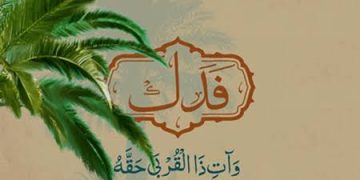
One of the principal pieces of evidence cited in this regard is verse 26 of Surah al-Isra:
وَآتِ ذَا الْقُرْبىٰ حَقَّهُ وَالْمِسكينَ وَابنَ السَّبيلِ وَلا تُبَذِّر تَبذيرًا
Translation:
“And give the relative his due, as well as the needy and the traveler, and do not spend wastefully.”
(Surah al-Isra, 17:26)
According to narrations recorded in various hadith and Qur’anic commentary sources, when this verse was revealed, the Prophet Muhammad (peace and blessings be upon him and his family) transferred Fadak to Lady Fatimah (peace be upon her). [7, 8, 9, 10]
This account has also been transmitted in a number of Sunni sources, including:
- Al-Durr al-Manthur, by Jalal al-Din al-Suyuti.
- Majma’ al-Zawa’id, by Nur al-Din al-Haythami.
- Mizan al-I’tidal, by Shams al-Din al-Dhahabi.
- Kanz al-Ummal, by Ali al-Muttaqi al-Hindi.
The narrations concerning this event also mention several Sunni hadith scholars and transmitters, including Abu Bakr al-Bazzar, Abu Ya’la al-Mawsili, Ibn Abi Hatim al-Razi, Ibn Mardawayh al-Isfahani, al-Hakim al-Nishapuri, al-Tabarani, Ibn al-Najjar al-Baghdadi, and others. [7, 8, 9, 10]
Accordingly, these reports constitute one of the principal foundations of the Shi’a argument concerning the Prophet’s gift of Fadak to Lady Fatimah (peace be upon her).
Lady Fatimah’s Demand for the Return of Fadak
Following the passing of the Prophet Muhammad (peace and blessings be upon him and his family), Fadak came under the control of the ruling authorities, and Lady Fatimah (peace be upon her) took steps to reclaim it.
According to historical accounts, Lady Fatimah stated that the Prophet had granted Fadak to her during his lifetime.
In response, Abu Bakr requested that she provide witnesses to substantiate her claim.
This issue represents one of the most important aspects of the historical dispute over Fadak. Yaqut al-Hamawi’s account also refers to Lady Fatimah’s demand for Fadak and Abu Bakr’s request for witnesses. [5]
The Principle of Ownership and the Burden of Proof
One of the important legal questions arising from this dispute concerns the principles governing ownership and the burden of proof.
According to established principles of Islamic jurisprudence, a person in possession of property enjoys a recognized legal position, while anyone making a claim contrary to that possession must provide evidence to substantiate it.
This principle is commonly expressed in Islamic jurisprudence through the following maxim:
“Al-bayyinah ‘ala al-mudda’i wa al-yamin ‘ala man ankara.”
“The burden of proof rests upon the claimant, while the oath rests upon the one who denies the claim.”
According to the Shi’a argument, if Fadak was already in Lady Fatimah’s possession and she claimed ownership on the basis of a gift from the Prophet, the legal significance of that possession and the evidence supporting her claim should also have been taken into consideration.
From the Shi’a perspective, the demand for witnesses from Lady Fatimah and the manner in which her claim was examined constitute some of the most important points of criticism concerning this historical incident.
Who Were Lady Fatimah’s Witnesses?
Accounts concerning the Fadak incident report that Lady Fatimah (peace be upon her) presented several individuals as witnesses to support her claim.
The individuals mentioned in these accounts include:
- Imam Ali ibn Abi Talib (peace be upon him).
- Imam Hasan al-Mujtaba (peace be upon him).
- Imam Husayn (peace be upon him).
- Umm Ayman.
Some historical and hadith reports also contain narrations attributed to Abu Sa’id al-Khudri and Ibn Abbas concerning this matter.
According to these accounts, the transfer of Fadak took place privately, in the presence of individuals who had direct knowledge of the event.
Therefore, the testimony of these individuals and the manner in which their statements were evaluated form an important part of the historical discussions surrounding Fadak. [7]
Why Is the Incident of Fadak More Than a Financial Dispute?
In light of the issues discussed above, it becomes clear that the incident of Fadak cannot be regarded merely as a disagreement over an agricultural estate.
This event raises several fundamental questions in Islamic history:
- The legal status of Fay’ property and the Prophet’s authority to administer it.
- The alleged gift of Fadak to Lady Fatimah and its Qur’anic and hadith-based evidence.
- The manner in which Lady Fatimah’s ownership claim was examined after the Prophet’s passing.
- The legal validity and evaluation of the witnesses presented in this case.
- The relationship between the conduct of an Islamic ruler and the principles of justice and the qualifications required for Imamate.
From the Shi’a perspective, these issues demonstrate that the Fadak incident is deeply connected to the question of Imamate and the status of the Ahl al-Bayt (peace be upon them).
Conclusion
The incident of Fadak is one of the significant and influential events in early Islamic history. Examining it requires simultaneous consideration of the Holy Qur’an, hadith narrations, historical sources, and Islamic jurisprudential and theological discussions.
According to the Shi’a argument and reports recorded in various Islamic sources, Fadak was a territory that came under the Prophet Muhammad’s control without military confrontation, and the Prophet subsequently transferred it to Lady Fatimah al-Zahra (peace be upon her). [4, 5, 7, 8, 9, 10]
Following the Prophet’s passing, Lady Fatimah sought to assert her right to the property; however, her claim became the subject of disagreement and controversy concerning ownership and the required evidence. [5, 7]
From the Shi’a perspective, the significance of this event is not limited to the economic value of Fadak. Rather, it represents broader discussions concerning rights, justice, the status of the Ahl al-Bayt, and the question of Imamate in Islamic history.
Therefore, a careful study of the Fadak incident and an examination of its supporting evidence in historical and hadith sources can contribute to a better understanding of the political and theological developments that followed the passing of the Prophet Muhammad (peace and blessings be upon him and his family).
References
[1] Sharif al-Jurjani, Sharh al-Mawaqif, vol. 8, p. 354.
[2] Sharif al-Jurjani, Sharh al-Mawaqif, vol. 8, pp. 349–350.
[3] Al-Qurtubi, Al-Jami’ li-Ahkam al-Qur’an, vol. 18, pp. 9–10; also Sahih Muslim, narration of Umar ibn al-Khattab concerning the property of Banu al-Nadir.
[4] Fakhr al-Din al-Razi, Al-Tafsir al-Kabir, vol. 15, p. 284.
[5] Yaqut al-Hamawi, Mu’jam al-Buldan, vol. 4, pp. 270–271, entry no. 9053.
[6] Marasid al-Ittila’ ‘ala Asma’ al-Amkinah wa al-Biqa’, vol. 3, p. 1020.
[7] Jalal al-Din al-Suyuti, Al-Durr al-Manthur, vol. 5, pp. 273–274.
[8] Nur al-Din al-Haythami, Majma’ al-Zawa’id, vol. 7, p. 49.
[9] Shams al-Din al-Dhahabi, Mizan al-I’tidal, vol. 2, p. 288.
[10] Ali al-Muttaqi al-Hindi, Kanz al-Ummal, vol. 3, p. 767.