Fatema the daughter of Asad, the son of Hashem – the Prophet’s great-grandfather after whom the monotheist Hashemite clan is known. Her marriage with Abu Taleb made the two the first ever Hashemite couple to enter the nuptial bond. She was the lady who nurtured in her lap two of the noblest ever persons of all time. In other words, if as the foster mother she brought up the future Prophet as her own son (following the death of his parents in early childhood), her own biological son, Imam Ali (AS), was destined to be the divinely-decreed vicegerent of the Almighty’s Last and Greatest Messenger to mankind.
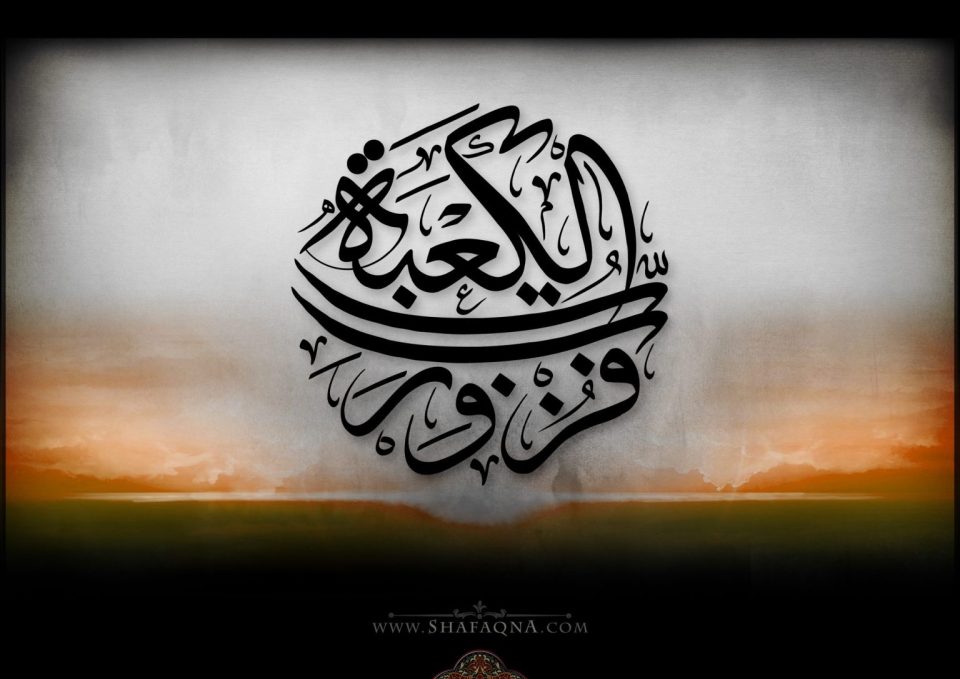
If for the miraculously pregnant Virgin Mary, God had ordered her to leave the sacred precincts of Bayt al-Moqaddas for delivery of Prophet Jesus (PBUH), for Fatema bint Asad, the Lord Most High made the walls of Abraham’s edifice, the holy Ka’ba, to miraculously part and close behind her, so that Imam Ali (AS) could be born in the holiest spot on Planet Earth.
Later she said: Allah preferred me to the virtuous ladiesof the past. Mary shook the trunk of the palm-tree and ripe dates fell upon her. I entered the House of Allah and ate fruits of paradise; and when I was about to leave the place, I heard the divine call: “O Fatema! Name your son Ali, because he has been exalted by the Lord Most High. His name is a derivative of My Own Name… I made known to him the intricacies of My Knowledge. He will smash and remove the idols installed in My House (Holy Ka\’ba). He is the one to call people to prayer from the roof of My House. Blessed are those who love him and woe to those who are his foes.”
All Islamic historians and compilers of hadith are unanimous that she was among the foremost Muslims and the second among women after the Prophet’s wife Hazrat Khadija (SA), to publicly declare faith in Islam.
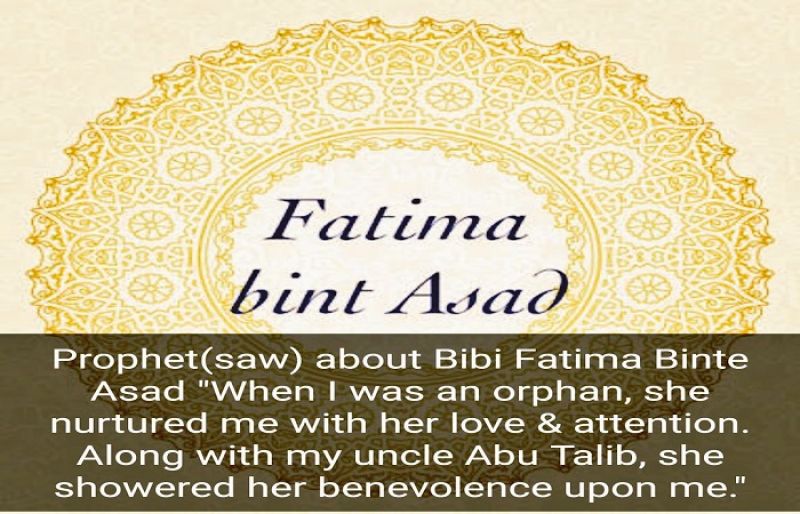
It was a great honour for Fatema bint Asad to be addressed as mother by Holy Prophet Mohammad (SAWA). He used to say that along with his uncle and guardian, Abu Taleb, she cared the utmost for him. When the Holy Prophet (SAWA) lost to the cold hands of death, his loyal wife, the Mother of all True Believers, Omm al-Momineen Khadija, he entrusted his orphaned daughter, Hazrat Fatema Zahra (SA) to the motherly care of his foster-mother, Fatema bint Asad.
Later in Medina, by virtue of the blessed marriage of Imam Ali and Hazrat Fatema Zahra (peace upon them), she became mother-in-law to the Prophet’s Immaculate Daughter. As we said last week, the two enjoyed very cordial relations. Hazrat Fatema Zahra (SA) never allowed Fatema bint Asad to trouble herself with household chores, and left to her the social relations for keeping the necessary contact with family members and friends. With the birth of the Prophet’s grandsons, Imam Hasan and Imam Husain (peace upon them), Fatema bint Assad became the proud paternal grandmother of the Leaders of the Youths of Paradise. Consequently, she is the ancestress of all Saadaat (plural of Seyyed), as all direct descendants of Hazrat Fatema Zahra (SA) are reverently called till this day.
Besides Imam Ali (AS), Fatema bint Assad was the mother of two other virtuous sons, Ja’far and Aqeel, who are immortal names in Islamic history. Ja’far was the first migrant in Islam. Following the death of his father Abu Taleb and the increase in the persecution of the fledgling Muslim community in Mecca, he was instructed by the Holy Prophet (SAWA) to migrate to Abyssinia or what is now called Ethiopia in the Horn of Africa.
He returned to Arabia some years later on the day his younger brother, Imam Ali (AS), single-handedly conquered the impregnable Israelite fortress of Qamous in the Khaiber region, north of Medina. Ja’far was entrusted with the command of the Muslim forces in some of the armed encounters that were imposed upon the Holy Prophet (SAWA) by the enemies of Islam. He achieved martyrdom, fighting bravely in the battle against a joint army of Christian Arabsand Romans in Mo’ta, which is now in Jordan.
Both his hands were cut off in the battle, and the aggrieved the Holy Prophet (SAWA) gave tidings of Ja’far being granted a pair of wings in paradise by God Almighty. Thus, posthumously he became famous in Islamic history as Ja’far at-Tayyar or the One who flies – like birds. The Holy Prophet (SAWA) took under his personal care Abdullah, Mohammad, and Aun, the orphaned sons of Ja’far, that is, the grandsons of his foster-mother Fatema bint Assad (peace upon her). Later on growing up, Abdullah and Mohammad were married respectively to their first cousins, Hazrat Zainab and Hazrat Kolsoum, the noble daughters of Imam Ali and Hazrat Fatema Zahra (peace upon them). In other words, all four were grandchildren of Fatema bint Asad.
As all books of hadith and history testify, Fatema bint Asad was a very virtuous and God-fearing lady. The degree of her faith could be gauged by the Holy Prophet\’s (SAWA) assurance to her of immunity from the constriction of the grave to which almost all dead bodies are subjected.He also gave tidings to her that on the Day of Resurrection when the dead are revived she will be among the pious ones who will be raised fully clothed for being extremely mindful of modesty.
Among other proofs of the pride of place in Islam of Fatema bint Asad is that, when she died the Holy Prophet (SAWA) gave his own tunic to be used as shroud, shouldered her bier, lay down himself for a while in her grave before her burial, and recited the “talqeen”in her ears in mournful tones, saying at one instance “ibnaki, ibnaki” which means “your son, your son.” When the companions asked him what he meant by these words while laying her foster-mother to rest, he replied: The angels asked my aunt about my mission of prophethood (nubuwwat) and she gave the exact answer, and when they questioned her about the issue of imamate (divinely-decreed leadership after the Holy Prophet (SAWA)), she was overcome with modesty, so I said: “(it is) your son, your son” –that is, Imam Ali (AS).
So profound was his state of grief that after the burial that the Holy Prophet (SAWA) sat down beside her grave for lengthy moments, weeping and supplicating to God. While returning from the Jannat al-Baqie Cemetery he told his companions that today he had become totally deprived of the munificence of his late uncle Abu Taleb. He said Fatema bint Asad (SA) loved him as her son, preferring him to her own children. He said God has sent 70,000 angels for her funeral prayer.
http://shiastudies.com