Hadith of Ghadir And the Succession of the Prophet Muhammad (PBUH)
The Hadith of Ghadir is one of the most widely-narrated and authentic traditions in Islam; it is narrated by no fewer than 120 Companions, ninety Successors and 360 Sunni scholars. Ibn Taymiyya (d. 728/1328), who harboured some enmity towards Imam Ali (AS), rejected the authenticity of the tradition. However, the latter-day representative of his school of thought, Nāṣir Al-Dīn Al-Albānī (1333–1424/1914–1999), criticised him for rejecting it without a thorough investigation of all of its parts. According to this tradition, after having people bear witness to the unity of God, his own prophethood and the Day of Judgment, the Prophet (PBUH) asked:
“Oh’ People! How will you treat the two weighty things after me?”
A man stood up and asked aloud, “What are they?” The Prophet (PBUH) responded,
“The greater one is the Book of God, one side of which is in God’s hand and the other is in yours. So hold fast to it lest you go astray. And the lesser one is my progeny (ʿItra). The All-Knowing One has informed me that these two will never be separated until they reach me at the Pool (Hawdh). I have asked Allah (SWT) to make this happen. Do not go ahead of them lest you perish, nor fall behind them lest you perish!”
Then, the Prophet (PBUH) held up Ali’s (AS) hand so that people could see the whites of their armpits and everyone could recognize him. The Prophet (PBUH) asked people,
“Who is more entitled (Awlā) to the believers than their own selves?”
The people replied, “God and God’s Messenger know best.” He added,
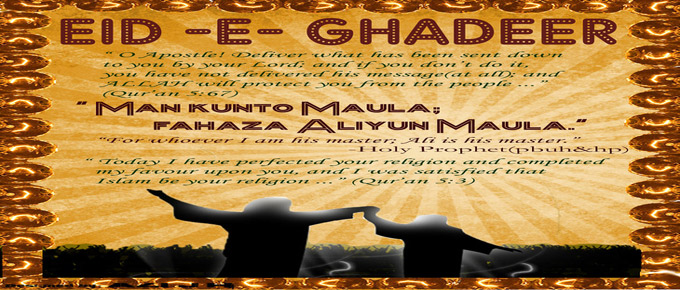
“God is my Master (Mawlā) and I am the master (Mawlā) of the believers. I am more entitled (Awlā) to the believers than their own selves? And whoever I am the master of, then Ali (AS) is his master too!”
The Prophet (PBUH) repeated this sentence for three times (or four times, as Ahmad ibn Hanbal relates). Then he added:
“Oh’ God! Be an ally to his allies and an enemy to his enemies, love those who love him and hate those who hate him, help those who help him and forsake those who forsake him. Turn rightness with him wheresoever he turns. And Lo! Let those who are present inform those who are absent!”
We would do well to ask what the purpose of such a large gathering of people was. If we take all of the Prophet’s (PBUH) words at Ghadir into consideration, we will find several good reasons to believe his only purpose in stopping all those people there in the heat of day was to announce his successor to them:
Firstly, the Prophet (PBUH) began his address by having people bear witness to the unity of God, the truth of Judgment Day and his own prophethood. Then he proceeds to the announce succession of Ali (AS). This implies that Ali’s succession to the Prophet (PBUH) is, in terms of its significance, on a par with those three fundamental principles of Islam. In other words, if he had intended to express his own friendship to Ali (AS) or to ask others to befriend him (as some have suggested based on the different means of the word Mawla), the Prophet (PBUH) would not have mentioned these fundamental beliefs.
Secondly, the Prophet (PBUH) asks people, “Who is more entitled (Awlā) to the believers?” before saying that “whoever I am the master of, then Ali is his master too!” Here, the Prophet (PBUH) clearly uses the word ‘Mawlā’ to signify authority over the people in their social and political affairs, and protecting their lives.
Thirdly, the Prophet (PBUH) informs the people of his imminent death: “I am soon to be called, and I must respond.” This suggests that he is thinking of and trying to make provisions for the Muslim society after his demise, particularly that there will be a leading authority for people to follow.
Fourthly, after declaring “whoever I am the master of, then Ali (AS) is his master too”, the Prophet (PBUH) added:
“God is greater, for the religion of Islam is perfected and the blessing is completed and God is now satisfied with my prophethood and Ali’s (AS) Wilāya.”
These sentences show that God’s religion was perfected and His blessing was completed with Ali’s succession to leadership (Wilāya) after the Prophet (PBUH) (Amīnī, 1/26, 27, 30, 32, 33, 34, 36, 47 and 176). Most clearly, the Prophet declares that God is now satisfied with his prophethood and Ali’s (AS) succession as the leader of Muslims.
Fifthly, after the Prophet (PBUH) had finished his address, Abu Bakr and Umar, along with many other Prophet’s (PBUH) Companions came to Imam Ali (AS) and congratulated him on the event, which lasted until sunset. Abu Bakr and Umar said to Imam Ali (AS), “Congratulations! Between the morning and evening of today, you have become the Mawlā of all Muslim men and women” (Amīnī, 1/27, 283).
Finally, those who do not dispute the authenticity of the tradition itself but claim that the Prophets (PBUH) words only meant that people should be friends of Ali should pay attention to the fact that it would be incompatible with the Prophet’s (PBUH) wisdom to stop a caravan of about one hundred thousand people in the heat of day only to tell them to be friends of Imam Ali (AS). Imam Ali’s (AS) friendship with the believers was not doubted, because as the Quran declares, all Muslims are brothers and friends to each other:
“The believers are but a single brotherhood’ (Q46:10) and ‘The believers, men and women, are protectors of one another” (Quran 9:71).
Two objections
Those who have investigated the Hadith of Ghadir accept its authenticity and the fact that its words were indeed uttered by the Prophet (PBUH). This is why the Companions, the Successors and later scholars have related the Hadith and confirmed that the Prophet (PBUH) said on the occasion of Ghadir: “whoever I am the master of, then Ali (AS) is his master too.” However, some have claimed that the Arabic word ‘Mawlā’ has never been used in Arabic in the sense of ‘Awlā’ (‘more entitled’) while those who employ this hadith, in fact, stress this meaning in order to establish Ali’s (AS) leadership after the Prophet (PBUH).
In response to this objection, we may remind the critics that the word ‘Mawlā,’ as many interpreters confirm, has actually been used in the Quran in the sense of ‘more entitled or proper.’ An example of this sense can be found in the following verse:
“So today no ransom shall be taken from you, nor from the faithless. The Fire is your proper abode: it is your refuge and an evil destination.” (Quran 57:15).