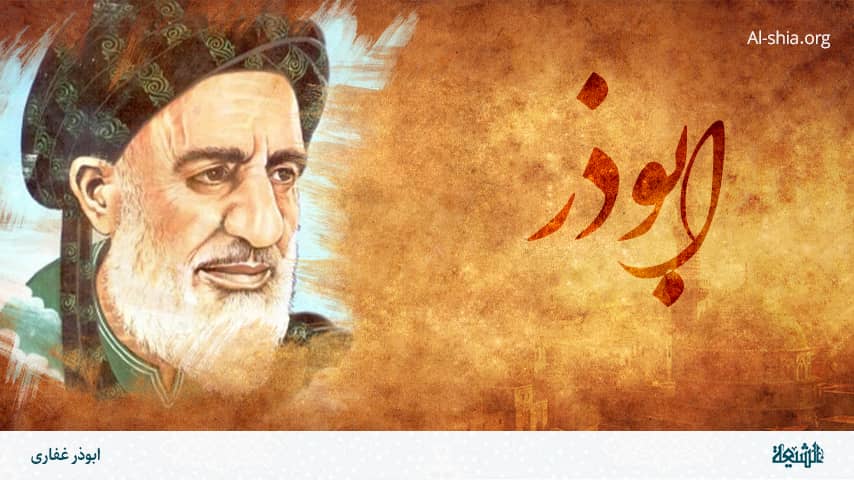
by Dr Ali Shariati*: No tricks would work against this obstinate, brazen, pious and conscious man. Only coercion remained. He wrote to Uthman: If you need Damascus, take Abu Dhar away from here because complexes are swelling, the heads of wounds have opened up and an explosion is near. Uthman ordered him to be sent to Medina.
They placed him in a wooden packsaddle on a camel’s back and engaged several savage slaves to take him back to Medina. Muawiyah ordered that no stops be made along the way, from Damascus to Medina.
The rider nears Medina, tired and wounded; beside the city, he saw Ali on Mt. Sala’ and beside him, Uthman and several other people. From a distance he cried out, “I give glad tidings to Medina of a great and endless rebellion.” The Caliph ordered no one to follow a religious edict from Abu Dhar but religious edicts were issued, one after another, by Abu Dhar. That which he had seen in Damascus, had made him more anxious and more brazen in struggle. Abd Al-Rahman ‘Awf, the head of the caliphate council of Umar, died and his heritage, which was an abundance of gold and silver, was piled up before Uthman. Abu Dhar heard that Uthman had said, “Abd al-Rahman is blessed by God that he lived well and when he died he left behind all of this wealth.”
The scene of the drama of all of history!
Abu Dhar agitated and enflamed, invaded Uthman’s house alone. On the way, he found a camel’s bone. He picked it up and took it. He cried out to Uthman, “You say that God has blessed a man who has died and left all of this gold and silver behind?”
Uthman, softly, replied, “Abu Dhar, does a person who has paid his zakat have other [religious] obligations, as well”.
Abu Dhar recited the verse of Kinz and said, “The problem here is not zakat; the problem is with anyone who hoards gold and silver and does not give it upon the Way of God.”
Ka’b Al-Ahbar, a clergyman, formerly Jewish, who was sitting beside Uthman, said, “This verse relates to the ‘people of the Book’ (Jews and Christians); it does not relate to Muslims.”
Abu Dhar cried out at him, “Son of a Jew! You want to teach our religion to us? May your mother mourn for you!” Uthman said, “If a man has paid his zakat and builds a palace, one brick of gold and one brick of silver there is no blame.” Then he turned to Ka’b and asked him his opinion and Ka’b expressed the opinion that, “Yes, your majesty. That’s the way it is!” Abu Dhar attacked him.
Ka’b, out of fear, hid behind Uthman and placed himself in the refuge of the Caliph. The scene is complete! The scene of the drama of all of history! On one side, gold, coercion and the ruling religion in the visages of ‘Abd al-Rahman, ‘Uthman and Ka’b Al Ahbar, and how exact and accurate! The principle, gold, coercion its supporter and religion, hidden behind coercion, its justifier. Confronting it, Abu Dhar, the sacrifice of exploitation, despotism and deception, the manifestation of the religion condemned by history and the oppressed class of history, God and the people!
Abu Dhar, alone, disarmed, oppressed, with all of this, responsible and an assailant, takes Ka’b from the refuge of coercion, and with the camel’s bone, pounded him so hard on the head that blood began to flow.
‘Uthman said, “How tiresome you have become, Abu Dhar; leave us.”
Abu Dhar said, “I am fed up with seeing you. Where should I go?”
“To Rabadhah.”
Marwan Hakam, an exile of the Prophet (PBUH), was assigned to exile Abu Dhar.
Ali heard of the affair. He moaned. He took Hassan (AS), Hussain (AS) and ‘Aqil (RA) and they came to see him off. Marwan stood before Ali (AS), “The Caliph has prohibited the seeing-off of Abu Dhar.” ‘Ali (AS) with a whip, by-passed him, and went with Abu Dhar till Rabadhah.
Rabadhah, a burning wilderness without water
Rabadhah, a burning wilderness without water or cultivation, along the way of pilgrims; which, other than at the time of the hajj, becomes empty and silent. There he set up his torn tent and he met his needs with the few goats he had.
Months passed. Poverty was increasing and hunger, more brazen. One by one, his goats died and he and his family faced death in the loneliness of the wilderness. His daughter died. He bore it patiently and considered it to have been upon the Way of God. A little later, the wolf of hunger attacked his son. He sensed responsibility. He went to Medina and sought his wages, which had been cut off, from Uthman. Uthman did not answer him. He returned empty handed. His son’s corpse was cold. He buried him with his own hands. Abu Dhar and Umm Dhar remained alone.
Poverty, hunger and decrepitude had greatly weakened Abu Dhar’s body. One day he felt he had come to the end of his strength. Hunger bothered him. He said to Umm Dhar, “Arise. Perhaps in this wilderness we will find some blades of grass to quiet our hunger a bit. Woman and man, for a great distance, from the parameters of the tent, searched and found nothing. Upon their return, Abu Dhar lost his strength. The sign of death showed itself in his face. Umm Dhar understood and, anxiously, asked, “What is happening to you, Abu Dharr?”
“He walks alone, dies alone and will be resurrected alone!”
“Separation is near! Leave my corpse on the way and ask wayfarers to help you bury me.”
“The hajjis have gone and there are no wayfarers.” “It can’t be. Get up and go on the hill. Some people will come for my death.”
Umm Dhar, from the top of the hill, saw three riders who were riding at a distance. She signalled to them. They came close.
“May God bless you. A man is dying here. Help me bury him and receive your reward from God.”
“Who is he?”
“Abu Dhar.”
“The friend of the Prophet (PBUH)?”
“Yea.”
“May my mother and father be sacrificed for you O Abu Dhar! ”
They stood before him. He was still alive. He requested of them, “Any of you who are messengers of the government, spies or military personnel, do not bury me. If my wife or I had a cloth for my shroud, there would be no need.”
Only a youth from among the Helpers who had a non-government profession said, “I have this cloth with me which my mother wove.” Abu Dhar prayed for him and said, “Shroud me with that.”
His mind at rest, everything was coming to an end. He closed his eyes and never opened them again. The wayfarers buried him under the hot sands of Rabadhah. The young Helper stood beside his grave, whispering under his breath, “The Prophet of God stated it well!”
He walks alone, dies alone and will be resurrected alone!
“When?”
“On the arising of the Day of Resurrection.”
“And, also, in the arising of every era and in the midst of every generation.”
And now, once again it is Abu Dhar who, among all of the visages buried in this shoreless cemetery of history, in our age and among us, will be resurrected alone.”
The End
Source:shafaqna