A refutation of the spurious claim that the Shi’ah believe in a different Qur’an than Sunnis do.
Do the Shi’ah Believe in a Different Qur’an?
Surely We have revealed the Reminder (Holy Qur’an) and We most surely are its Guardian. (Holy Qur’an: Chapter 15, Verse 9)
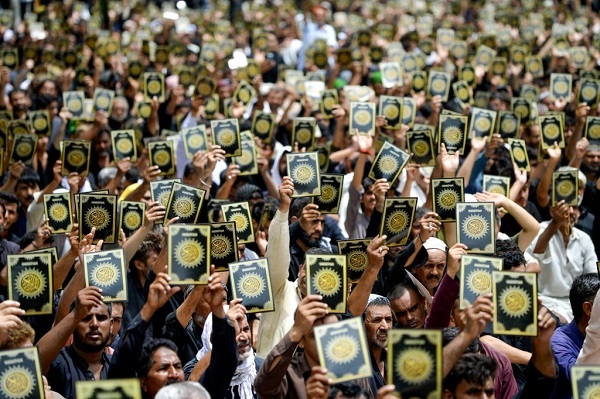
The Shi’ah are frequently accused of belief in Tahrif in Holy Qur’an which means believing that the Holy Qur’an has been tampered with and is not the same as the one revealed to the Prophet (s).
THIS IS NOT true !!!
All great Twelver Shi’ah scholars from the earliest period to the present century have believed in the complete preservation of the Holy Qur’an. Some famous early Shi’ah scholars who have clearly stated this belief in their books include:
• Shaykh al-Saduq (d. 381 AH), Kitabu’l-Itiqadat, (Tehran, 1370) p. 63.
• Shaykh al-Mufid (d. 413 AH), Awa’ilu l-Maqalat, pp. 55-6;
• Sharif al-Murtada (d. 436 AH), Bahru ‘l-Fawa’id (Tehran, 1314) p. 69;
• Shaykh at-Tusi (d. 460 AH), Tafsir at-Tibyan, (Najaf, 1376), vol 1 p. 3;
• Shaykh at-Tabrasi (d. 548), Majma’u ‘l-Bayan, (Lebanon), vol. 1 p. 15.
Some of the later scholars who spelt out the same views include:
• Muhammad Muhsin al-Fayd al-Kashani (d. 1019 AH), Al-Wafi, vol. 1 pp. 273-4, and al-’Asfa fi Tafsir al-Qur’an, p. 348;
• Muhammad Baqir al-Majlisi (d. 1111 AH), Bihar al-’Anwar, vol. 89 p. 75
This belief has continued uninterrupted up to the present time. Shi’ah scholars of this century who have reiterated the belief that the Qur’an is completely protected and unchanged include such famous names as:
• Sayyid Muhsin al-Amin al-’Amili (d. 1371 AH);
• Sayyid Sharaf al-Din al-Musawi (d. 1377 AH.);
• Shaykh Muhammad Husayn Kashif al-Ghita’ (d. 1373 AH);
• Sayyid Muhsin al-Hakim (d. 1390 AH);
• ‘Allamah al-Tabataba’i (d. 1402 AH);
• Sayyid Ruhullah al-Khumayni (d. 1409 AH);
• Sayyid Abu al- Qasim al-Khu’i (d. 1413 AH)
• Sayyid Muhammad Rida al-Gulpaygani (d.1414 AH).
This, of course, is not an exhaustive list.
Q: But what about the Shi’ah before these scholars, didn’t they all believe in tahrif?
Not at all! Consider the example of ‘Ubaydullah b. Musa al-’Absi (120-213 AH), a devoted Shi’ah scholar whose narrations from the Imams can be found in the famous Shi’ah hadith collections such as al-Tahdhib and al-Istibsar. Now let’s see what some Sunni scholars have to say about him:
• “… a pious person, one of the important Shi’ah scholars … he was considered reliable by Yahya b. Ma’in, Abu Hatim said he was reliable, trustworthy … al-’Ijli said that he was an authority on the Qur’an…” [Al-Dhahabi, Tadhkirat al-Huffaz (Haydarabad, 1333 AH), vol. 1 p. 322]
• “… he was an imam in fiqh and hadith and Qur’an characterized by piety and righteousness, but he was one of the chiefs of the Shi’ah.” [Ibn al-’Imad al-Hanbali, Shadharat al-Dhahab (Cairo, 1350 AH), vol. 2 p. 29]
None of these Sunni scholars would have praised him for his knowledge of the Qur’an if they thought he believed in a different Qur’an!!!
And ‘Ubaydullah was considered so trustworthy, despite being a Shi’ah, that the famous Sunni traditionists al-Bukhari and Muslim as well as many others narrated scores of traditions from him in their hadith collections! [The Creed of the Imaam of Hadeeth al-Bukhari (Salafi Publications, UK, 1997), pp. 87-89]
Q: Don’t the Shi’ah believe in Mushaf Fatimah which is three times the size of the Qur’an?
The Qur’an is a Mushaf (book), but any book is not necessarily the Qur’an! There is no Qur’an of Fatimah! Mushaf Fatimah was a book written or dictated by Fatimah (a) after the Prophet’s (s) death. It is not a part of Qur’an and has nothing to do with Allah’s commandments or legal rulings.
Q: But are there not traditions in Shi’ah collections that mention verses of the Qur’an containing extra words than what we have today?
There are some instances where extra words are indicated only by way of explanation, they do not imply that the original Qur’anic text is being distorted. This happens in both Shi’ah and Sunni sources. Consider the following two examples, both from famous Sunni commentaries of the Qur’an:
• “Ubayy b. Ka’b used to read ‘… then as to those whom you profit by for an appointed period give them their dowries as appointed…’ (Qur’an Chapter 4, Verse 24) and this was also the recitation of Ibn ‘Abbas.” [Fakhr al-Din al-Razi, Mafatih al-Ghayb (Beirut, 1981), vol. 9 p. 53] [Ibn Kathir, Tafsir al-Qur’an al-’Azim (Beirut, 1987), vol. 2 p. 244]
A footnote in Ibn Kathir’s Tafsir explains that the additional words indicated above, which are not part of the Qur’an, were recited by these Companions of the Prophet (s) only by way of tafsir and explanation.
• “Ibn Mas’ud said: In the days of the Prophet (s) we used to recite, ‘O our Messenger (Muhammad) deliver what has been sent down to you from your Lord that ‘Ali is the master of the believers if you do not, then you have not delivered His message.’ (Qur’an Chapter 5, Verse 67) [Jalal al-Din al-Suyuti, Durr al-Manthur, vol. 2 p. 298]
In this case as well, the part in italics is certainly not part of the Qur’anic text, however the Companion Ibn Mas’ud used to recite it in this way to explain the context of its revelation.
Q: But what about those traditions that say a number of revealed verses are no longer part of the Qur’an?
The Shi’ah do not believe in the immunity of any writer, commentator or narrator from mistakes, and, therefore, they do not take any collection of hadith to be completely valid and correct. The only book which is completely immune from any mistake is the Qur’an. These traditions are mostly considered as weak or interpreted as referring to non-Qur’anic revelation.
• It is interesting to point out that there are numerous traditions reported in Sahih al- Bukhari and Sahih Muslim which allege that many verses of Qur’an are missing. [Al-Bukhari, Al-Sahih, vol. 8 p. 208; Muslim, Al-Sahih, vol. 3 p. 1317]
• Not only that, these Sunni reports allege that two chapters from the Qur’an are missing with one of them similar to the Chapter of al-Bara’ah (chapter 9) in length!!! [Muslim, Al-Sahih, Kitab al-Zakat, vol. 2 p. 726]
• Some Sunni traditions even claim that the Chapter al-Ahzab (chapter 33) was as lengthy as the Chapter of al-Baqarah (chapter 2)!!! The Chapter of al-Baqarah is the biggest Chapter of the Qur’an. The traditions in Sahih al-Bukhari and Muslim even detail some of the missing verses. [Al-Bukhari, Al-Sahih, vol. 8 p. 208]
Yet, fortunately the Shi’ah never accuse the Sunni brothers and sisters of believing that the Quran is incomplete. We say that either these Sunni reports are weak or fabricated.
Conclusion
“It is our belief that the Qur’an which Allah revealed to His Prophet Muhammad (s) is (the same as) the one between the two covers (daffatayn). And it is that which is in the hands of the people, and is not greater in extent than that… And he who asserts that we say that it is greater in extent than this (the present text) is a liar.” [As-Saduq, Kitabu’l-I‘tiqadat (Tehran: 1370 AH) p. 63; English translation, The Shi’ite Creed, tr. A.A.A. Fyzee (Calcutta: 1942) p. 85]
source:alhassanain