by Dr Ali Shariati*: These stupid statues have all guaranteed the satanic seeking of exclusivenesses for their ‘carver-worshippers’. It is the first time that Abu Dhar sees like this and, with wonder and anger, asks himself, “What are these three hundred and some multitheistic idols doing in the monotheistic house of Abraham?”
He hurriedly descends from Safa, a migrant, alone, enflamed and determined. It seemed as if he was Muhammad who was enflamed that night arising from the first flame of revelation, leaving the cave, descending from Hira; or he was like a stone, which an earthquake grinds out of a mountain, falling upon the deep valley of Mecca, upon the heads of multitheism, hypocrisy, humiliation and sleep.
Islam is still hidden in the house of Arqam. This house is the whole world of Islam and the Ummah, with the coming of Abu Dhar, became four persons. The condition of dissimulation, Taqiyah, rules the struggle. He has been requested to leave Mecca, without hesitation, to return to the Ghifar and to await the command. But the bony breast of this ‘child of the wilderness’ is weaker than to be able to hide such a fire within himself. Abu Dhar, whose tall, thin body is a minaret for the temple of his faith, who is nothing other than the throat of a cry, and his shape, with his burning heart and in submission to the expansive desert, seemingly full of rebellion, was suddenly congealed and became Abu Dhar, is not capable of dissimulation; is rebellion itself, such a situation requires ability and he is unable. “God charges no soul save to its capacity.” (Quran 2:286)
Abu Dhar announces his belief in the mission of Muhammad (PBUH)
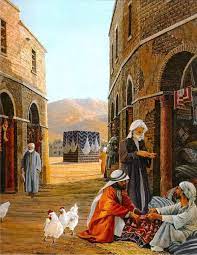
In front of the Kaaba, face to face with frightful idols, beside the Dar Al-Naduh, the Quraysh senate, he stands and shouts out the cry of monotheism; he announces his belief in the mission of Muhammad; he calls the idols’ mute stones which they themselves had carved’.
And this was the first cry which Islam brought; the first time that a Muslim rebelled against multitheism. The answer of multitheism was clear, death! a death which will be a lesson for others. This first throat of a cry must be cut off. Without hesitation, they fell upon him and pounded his head, face, breast and sides in fury until they cut off his ‘kufr-like’ cries.
Abbas came. The uncle of the Prophet, who was a usury collector and of the same class as the Quraysh aristocrats and multitheistic capitalists, frightened them saying, “This man is from the Ghifar. If you kill him, the Ghifar swords will take out their revenge against your caravans!”
They must decide between their religion and their world, deity or goods? A Qiblah of love or caravan of money. Which?
They pulled back without hesitation. Abu Dharr, like a statue, polluted with blood and broken, in the center of a circle of a crowd which, frightened, look at their only captive, with difficulty, tries to arise. The diameter of the circle grows larger. He arises. He supports himself on his own two feet. The crowd becomes more dense; it is as if they seek refuge in each other. It is here that coercion fears faith. He is one visage and they are visageless, personality-less, all alone and all without identity, an abundance of herds and confronting them, a human being, a person; a person who faith gave meaning, substance, ideals, orientation, attack and a wonderful, miracle-like, defeatless power which martyrdom grants to a believer.
Prophet (PBUH) assigned Abu Dhar the task of inviting the Ghifar tribe to Islam
He took off. He pulled himself to the Zamzam well. He washed his injuries. He cleansed away his blood. On the morrow he returned to the scene and once again he went to the edge of death. Abbas came and introduced him, “He is from the Ghifar tribe …” and again on the morrow. Until the Prophet, not this time to preserve the life of Abu Dhar, but with a command, moved this restless rebel from the city of suffocation and danger and assigned him the task of inviting the Ghifar tribe [to Islam]. Abu Dhar brought his family and, little by little, all of his tribe to Islam. He was with the Ghifar when the Muslims passed through the difficulties of the struggle in Mecca, when they undertook the migration and, when in Medina, they moved from the stage of individualization to the stage of founding a social system and, as a consequence, wars began.
It is here that Abu Dhar senses that he should be on the scene, goes to Medina and there, as he has no place or work, he makes the Prophet’s mosque his home, which at that time was the home of the people and he joins the Saffah Companions. He sacrifices living for ideology. In serving the movement, in times of peace, thought, knowledge and prayer and, in times of war, wars.
Islam, under the leadership of the Prophet, saturates all of the human needs and social desires of Abu Dhar; Islam, based in monotheism, opened the gate of struggle, one side of which is God, equality, religion, bread, love and power, and, on the other side, the arrogant, despotic tyrant, discrimination, kufr and hunger, and, its religion which requires weakness and disgrace. Islam, for the first time, put an end to the fairy-tale of the plundering oppressors who had made the slogan of ‘to want either this world or the next’, the faith of the people, so that ‘the next world’ would be for the people and ‘this world’ for themselves, and, in this way, they grant divine sanctity to poverty.
Islam brought a real Revolution into being which said, “Poverty is Kufr”
In this inhuman perception, Islam brought a real Revolution into being which said, “Poverty is kufr.” “Whosoever does not have a livelihood, will not be saved.” “Divine grace, great wealth [for society], goodness and virtue are part of material life and ‘bread’ is the infrastructure to worshipping God.” “Poverty, humiliation and weakness, and with all of these, religion, spirituality and piety in one society?” It is a lie! It is because of this that the Prophet of Abu Dhar is an armed Prophet; his monotheism is not a subjective, spiritual, individual philosophy. It is the inseparable support of unity of races, unity of classes and equity, every person according to his share and right, that is, the deterministic supra-structure of monotheism is not realized simply with the word; the sword must accompany the message.
It is because of this that Abu Dhar releases his material personal life, because a person who fights the hunger of others must accept his own hunger and that person can give liberty to his society who has passed through his own liberation, and calls for ‘revolutionary devotion’ which is Islamic austerity and the austerity of Ali, so that people would be provided with materiality and economic equality, not a Christian or Buddha like Sufi austerity.
It was as this that this revolutionary religion, this ‘both this world and the next’, the religion of neither weakness nor monasticism nor deprivation nor alienation from nature and ‘Last-Day-toxication’ of human beings in nature, was a religion ‘making the human being sacred in nature’, ‘vice gerent of God in the material world’! His leader, and before all others, his Prophet, was living in the mosque, the House of God-people: Muhammad, Ali, and the Saffah Companions: Salmans and Abu Dhars.
And Abu Dhar himself could be found under a covered porch (saffah) in the corner of the mosque at the heighth of success; he had become one of the most intimate friends of the Holy Prophet. Whenever he was not in a group, the Prophet would ask him; whenever there was [a group], he would turn to him in the midst of speaking under the leadership of the Prophet (PBUH), in the Battle of Tabuk when the soldiers, with difficulty, must pass through the burning northern desert to reach the borders of [eastern] Rome, Abu Dhar fell behind.
His skinny camel stopped, he freed him under the rain of fire and set off alone! He found some water; he took it to give it to his ‘friend’ who was also, doubtlessly, suffering from thirst in such a desert. The Prophet and the mujahids saw that an unclean point was moving forward in the depths of the fiery desert. Little by little they sensed that it is a human being! ‘Who is it? Walking and in such a flaming desert, alone, at that?
The Prophet, with an ardency overflowing with desire, cried out, “Would that it be Abu Dhrr!” An hour passed. It was Abu Dhar. When he reached the mujahids, he fell from thirst and exhaustion.
“You are carrying water and you are thirsty, Abu Dhar?” [the Prophet (PBUH) asked]
“I thought, in such a desert and, under such a sun, you …” [Abu Dhar replied].
“May God bless Abu Dhar! He walks alone, dies alone and will be resurrected alone!” [the Prophet said].
*And Once Again Abu-Dhar, Mashhad, Iran 1955
Source: shafaqna