by Ayatollah Seyyed Kamal Faqih Imani
بِسْمِ اللهِ الرَّحْمنِ الرَّحِيمِ
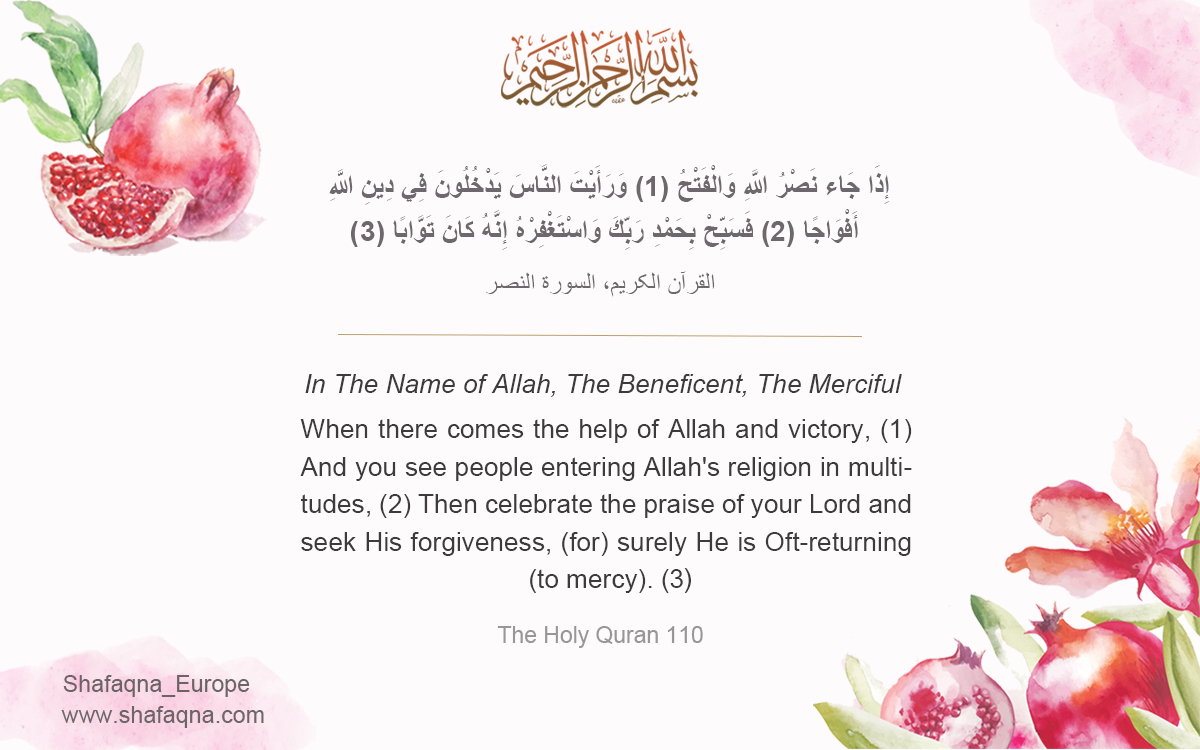
إِذَا جَاء نَصْرُ اللَّهِ وَالْفَتْحُ (1) وَرَأَيْتَ النَّاسَ يَدْخُلُونَ فِي دِينِ اللَّهِ أَفْوَاجًا(2) فَسَبِّحْ بِحَمْدِ رَبِّكَ وَاسْتَغْفِرْهُ إِنَّهُ كَانَ تَوَّابًا(3)
In The Name of Allah (SWT), The Beneficent, The Merciful
1. “When there comes the help of Allah (SWT) and victory”,
2. “And you see people entering Allah’s (SWT) religion in multitudes”,
3. “Then celebrate the praise of your Lord and seek God’s forgiveness, (for) surely God is Oft-Returning (to mercy)”.
Allah’s (SWT) Help Brings Multitudes to Allah’s (SWT) Religion
In these three short but expressive verses, there are some elegant, elaborations whose careful observation helps us to understand the final goal of the Surah. In the first verse, it says that the victory belongs to Allah (SWT). It is not only in this occurrence that this meaning is mentioned, but, in many other verses of the Qur’an the idea is reflected, including Surah Al-Baqarah, No. 2, verse 214:
and Surah Aal-e-Imran, No. 3, verse 126; and also Surah Al-Anfal, No. 8, verse 10, says:
It is true that preparation and supplying forces are necessary for defeating the enemy, but a believing person knows the victory comes only from Allah (SWT), and for the same reason when victory comes he does not become deluded or proud, but thanks and praises Allah (SWT)…
In this Surah, the words are about, at first, the help of Allah, then, the victory, and then, the influence and spread of Islam, and finally, the entering of people, in groups, into the religion of Allah (SWT). All of them are causes and effects for each other. Victory is absent unless there is the help of Allah (SWT), and people do not enter Islam in multitudes unless there is triumph and victory in order to remove the barriers and hindrances from the way. Of course, along with these stages, each of which is a great, divine blessing, the stage of being thankful and praising Allah; comes forth.
On the other hand, the help of Allah (SWT); and the victory are all for the final goal, i.e., people entering Allah’s (SWT) religion in multitudes, and guidance for all. Victory, here is stated in general, and with some evidences that were mentioned before, the purpose is, undoubtedly, the conquest of Mecca which had such a wide effect and verily, the conquest of Mecca introduced a new chapter in the history of Islam, because the main center of polytheism was disturbed; idols were destroyed; the hope of the idol worshippers changed into disappointment; and the barriers in the way of people’s faith in Islam were removed.
That is why the conquest of Mecca should be considered as a stage of the settlement of Islam in Arabia and then, in the world. It was after the conquest of Mecca that no opposition from the pagans was seen (except once, which was quickly controlled) and people from all parts of Arabia came to the holy Prophet (PBUH) to accept Islam.
There are three important instructions, in the verse, given to the holy Prophet (PBUH) (and naturally to all believers) which are, in fact, a gratitude for this great victory and an appropriate response to the help of Allah: the instructions of celebrating, praising, and seeking His forgiveness. This great victory caused the polytheistic thoughts to disappear; the perfection and beauty of Allah (SWT) to become more clear; and those who had lost the right way to return to the truth.
Further, it is possible that at the time of victory, some disgraceful behaviour appears in a person and he becomes involved in pride and self-conceit, or tries to take revenge and clear the personal accounts against his enemy. These three instructions train him ‘to remember the attributes of perfection and the beauty of Allah (SWT) at the sensitive moments of victory’; and ‘to know all of the effects from God’; and ‘to seek God’s forgiveness in order to both remove pride and negligence from himself; and avoid revengefulness’.
It is certain that the holy Prophet (PBUH) of Islam, like all other prophets (AS), was sinless; then what is the instruction of seeking God’s forgiveness for?
To answer this question, it should be said that this is a model for the whole community, and on the part of a sinless, infallible one like the holy Prophet (PBUH) and his Ahlul-Bait (AS) who have already been purified by the Lord (1) will mean seeking further grace and greater blessings or further protection of the Lord against the forces of Satan.
Here, /Istiqfar/ means holy Prophet’s (PBUH) beseeching the protection of the Lord, for himself and his followers, against the forces of evil, and seeking pardon of the Lord on behalf of his faithful adherents who, might have been prey of human weakness, as did Moses for his people who had yielded to the worship of the calf.
The phrase
is the statement of reason in proportion to ‘seeking forgiveness’, that is, seek forgiveness and repent because Allah (SWT) is Oft-Returning (merciful)’.
By the way, it may also refer to the meaning that ‘when Allah (SWT) accepts your repentance, you, too, should accept the repentance of the guilty after victory, as far as you can, and do not repulse them from yourselves as long as there is no sign of offence or plot coming from them.’ So, the holy Prophet (PBUH), himself, on the event of the conquest of Mecca, showed the feature of Islamic grace and mercy to his defeated, hostile enemies at its highest standard.
It was not only the holy Prophet (PBUH) who celebrated Allah’s grace and glory on his final victory against his enemies, but all prophets throughout history also did so. For example, when Joseph (AS) became exalted in Egypt and his parents and his brothers succeeded in seeing him after a very long time, he said:
Or, when Solomon (as) saw the throne of Bilqis (Queen of Sheba) ready before him, he said:
The conquest of Mecca was the greatest victory. After that conquest, whole tribes from all parts of Arabia gave their allegiance to the holy Prophet (PBUH), collectively, and before his earthly ministry was finished, the ground was prepared for the introduction of Islam to the world.
What was the lesson to be learned from this episode in world history? It was not about Man’s self-glory, but humility; not power, but, service; not an appeal to Man’s selfishness or self-sufficiency, but, a realization of Allah’s (SWT) Grace and Mercy, and the abundant outpouring of Allah’s (SWT) Praises in word and conduct.
source:shafaqna