• Home
  • Bank of Subjects of Articles
    • Bibliography
    • Characters
    • Culture and art
    • Economics
    • Educational sciences
    • ethics
    • Geography of Islamic world
    • History
    • Islamic jurisprudence and principles
    • Kalam (Islamic scholastic theology)
    • Mahdism
    • Philosophy and logic
    • Political science
    • pray and pilgrimage
    • Prophet and Ahl-al bayt
  • Islamic Teachings
  • quran
  • The Infallibles
  • Shia Beliefs
  • Morality
  • Events
    • Media Reflection
    • Muharram
    • News of Shia World
    • News of Worldly Assembly for Shia Studies
  • Home
  • Bank of Subjects of Articles
    • Bibliography
    • Characters
    • Culture and art
    • Economics
    • Educational sciences
    • ethics
    • Geography of Islamic world
    • History
    • Islamic jurisprudence and principles
    • Kalam (Islamic scholastic theology)
    • Mahdism
    • Philosophy and logic
    • Political science
    • pray and pilgrimage
    • Prophet and Ahl-al bayt
  • Islamic Teachings
  • quran
  • The Infallibles
  • Shia Beliefs
  • Morality
  • Events
    • Media Reflection
    • Muharram
    • News of Shia World
    • News of Worldly Assembly for Shia Studies
Home Bank of Subjects of Articles The Quran

Significance of Ayatul Kursi

by mustafa askari
2022-06-28
in The Quran
0
Significance of Ayatul Kursi
0
SHARES
1.7k
VIEWS
Share on FacebookShare on Twitter
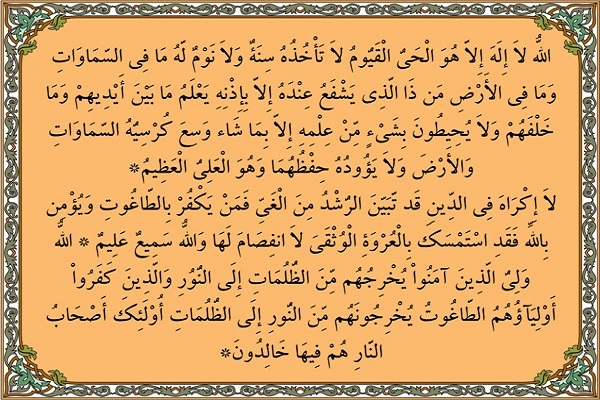
 A verse of the Holy Quran known as Ayatul Kursi has special importance and virtue due to the subtle and significant teachings it contains.


Ayatul Kursi is very well known among Muslims. There is a Hadith narrated from the Holy Prophet (PBUH) that describes verse 255 of Surah Al-Baqara as the most important and noble verse in the Holy Book. This verse has been known as Ayatul Kursi since the beginning and the Holy Prophet (PBUH) has mentioned this name in the Hadith.

The special importance attached to the verse is because of the sublime teachings it contains, including the phrase “Allah! There is no god ˹worthy of worship˺ except Him,” which denotes pure Tawheed (monotheism).

“Allah! There is no god ˹worthy of worship˺ except Him, the Ever-Living, All-Sustaining. Neither drowsiness nor sleep overtakes Him. To Him belongs whatever is in the heavens and whatever is on the earth. Who could possibly intercede with Him without His permission? He ˹fully˺ knows what is ahead of them and what is behind them, but no one can grasp any of His knowledge—except what He wills ˹to reveal˺. His Seat encompasses the heavens and the earth, and the preservation of both does not tire Him. For He is the Most High, the Greatest.”

The names of God and His attributes have been mentioned in this verse 16 times. That is why Ayatul Kursi is referred to as the motto and message of Tawheed. La Ilaha Illa Allah (There is no God but Allah) is the identity of every Muslim and the first motto and invitation of the Holy Prophet (PBUH). Belief in it is the source of salvation for every human being. Belief in Tawheed makes one regard all powers and attractions as insignificant. An example of the lessons of Tawheed is that Muslims would not prostrate before kings and the powerful.

The word Ever-Living means that death and inexistence are meaningless when it comes to God. All-Sustaining signifies God’s sustaining of the world constantly. The fact that neither drowsiness nor sleep overtakes Him means His attention to the world is endless. And He owns everything that there is: To Him belongs whatever is in the heavens and whatever is on the earth.

Without His permission, no one has the power to intercede, which is another emphasis on God’s oneness in power and will. So it denies any idol or entity that seeks to undermine God’s dominance.

The word Kursi (seat) should not be viewed as a physical thing and a seat on which God sits but, as Allameh Tabatabaei puts it, Kursi is a rank in the ranks of God’s knowledge which no one can measure. It signifies God’s power and dominance over the heavens and the earth. The phrase “He ˹fully˺ knows what is ahead of them and what is behind them” also refers to God’s infinite knowledge about the present and the future. It indicates that all things spread in time and space are in one place that is God’s knowledge and it has been referred to as Kursi.

source:iqna
Tags: AllahEthicsImam 'AliIslamJurisprudenceQuran
Previous Post

The Right of Legs: Commentary on Imam Sajjad’s (AS) Treaties of Right

Next Post

Two Points about God’s Provision of Sustenance

mustafa askari

Related Posts

Burning Will Not Make ‘Mighty’ Quran Vanish
The Quran

Burning Will Not Make ‘Mighty’ Quran Vanish

by mustafa askari
2023-07-31
The Qur’an’s Addressees
The Quran

The Qur’an’s Addressees

by mustafa askari
2023-07-17
When Will the Gates of Hell Open?
ethics

When Will the Gates of Hell Open?

by mustafa askari
2023-07-12
Quran Warns People against Hasty Judgments
The Quran

Quran Warns People against Hasty Judgments

by mustafa askari
2023-05-09
Tehran Int’l Quran Expo: Quran Translations in Different Languages on Display at India’s Pavilion
The Quran

Tehran Int’l Quran Expo: Quran Translations in Different Languages on Display at India’s Pavilion

by mustafa askari
2023-04-11
Next Post
Two Points about God’s Provision of Sustenance

Two Points about God’s Provision of Sustenance

Leave a Reply Cancel reply

Your email address will not be published. Required fields are marked *

Latest Post

10 facts about marriage in Islam

10 facts about marriage in Islam

2025-05-26
A Clear Message in Response to the Arrogance of Donald Trump

A Clear Message in Response to the Arrogance of Donald Trump

2025-05-24
The Grand Ayatollah Sistani & the Grand Ayatollah Javadi Amoli Met in Najaf Ashraf

The Grand Ayatollah Sistani & the Grand Ayatollah Javadi Amoli Met in Najaf Ashraf

2025-05-19
Imam Ali (AS) Did Not Compromise on Unethical Politics

Imam Ali (AS) Did Not Compromise on Unethical Politics

2025-05-11
UK: Reform councillors face allegations of sharing social media Islamophobic content

UK: Reform councillors face allegations of sharing social media Islamophobic content

2025-05-11
How to be just with your children?

How to be just with your children?

2025-05-10
Load More

Browse by Tags

Ahl al-Bayt (A.S.) Ahlul Bayt Al-Mahdi (AS) Allah Ashura Ayatollah Sobhani Ethics faith Fatima fiqh ghadir God History Holy Prophet Imam 'Ali Imam Ali (A.S.) Imam Husain Imams infallibles Islam Islamic Laws Islamic rules Jurisprudence Karbala Martyrdom morality Muhammad Nahj al Balaghah prayer prophet Quran Ramadan Reborn Salat Sayed Moustafa Qazwini shaistudies shia Shia Beliefs Shia Imams Shia Islam Shia Studie's World Assembly shiastudies Sin the differences between Shi’a and Sunni the story of those who converted to Shia Islam

The World Assembly of Shiite Studies was established in 2003 (1382 AH) by a group of scholars from seminaries and universities. The purpose of founding this independent academic institution was to introduce the school of Shi‘ism and defend its legitimacy through education, research, translation and publication, communications, and Islamic promotion. This center has continued its mission with strength and determination and envisions a bright future ahead.

Address: Qom, 45-Meter Ammar Yaser Boulevard, between Alley 4 and 6, World Assembly of Shiite Studies, Secretariat of Religious Scholars

Phone: +982537713773

Fax: +982537713774

All rights of the website are reserved and belong to the World Assembly of Shiite Studies.

Are you sure want to unlock this post?
Unlock left : 0
Are you sure want to cancel subscription?