• Home
  • Bank of Subjects of Articles
    • Bibliography
    • Characters
    • Culture and art
    • Economics
    • Educational sciences
    • ethics
    • Geography of Islamic world
    • History
    • Islamic jurisprudence and principles
    • Kalam (Islamic scholastic theology)
    • Mahdism
    • Philosophy and logic
    • Political science
    • pray and pilgrimage
    • Prophet and Ahl-al bayt
  • Islamic Teachings
  • quran
  • The Infallibles
  • Shia Beliefs
  • Morality
  • Events
    • Media Reflection
    • Muharram
    • News of Shia World
    • News of Worldly Assembly for Shia Studies
  • Home
  • Bank of Subjects of Articles
    • Bibliography
    • Characters
    • Culture and art
    • Economics
    • Educational sciences
    • ethics
    • Geography of Islamic world
    • History
    • Islamic jurisprudence and principles
    • Kalam (Islamic scholastic theology)
    • Mahdism
    • Philosophy and logic
    • Political science
    • pray and pilgrimage
    • Prophet and Ahl-al bayt
  • Islamic Teachings
  • quran
  • The Infallibles
  • Shia Beliefs
  • Morality
  • Events
    • Media Reflection
    • Muharram
    • News of Shia World
    • News of Worldly Assembly for Shia Studies
Home The Infallibles

A Glimpse on the Fatima (sa): the daughter of Prophet Muhammad (s)

by mustafa askari
2022-12-11
in The Infallibles
0
A Glimpse on the Fatima (sa): the daughter of Prophet Muhammad (s)
0
SHARES
81
VIEWS
Share on FacebookShare on Twitter

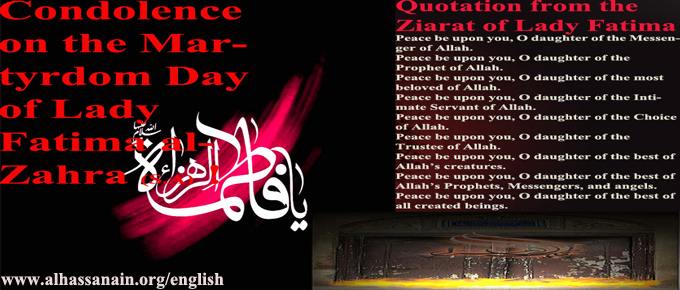
13th Jamadi-al-Awwal, according to some historical reports, is the death anniversary of Hazrat Fatima Zahra(sa) – the beloved and only genetic daughter of Prophet Mohammad (s). However the more widely accepted date of her death is the 3rd of Jamadi-ul-thani.
The Prophet of Islam had only one blood daughter named Fatima (as) from Khadija. There were three other ladies in the Prophet household these were: Zaynab, Ruqayya and Umm Kulthum who were related to Hazrate Khadijia. When the Prophet married they were part of the household they married away.
Of Hazrate Fatima (SA) we know that she was born five years after Besath (Declaration of Prophet hood) when Muhammad (S) was about 45 years old and her mother Khadija was about 55 years old. The date of her birth is reported to be the 20th of Jumada al-Awwal.
She is known by her many titles:
Al-Siddiqah (The Honest One)
Al-Mubarakah (The Blessed One)
At-Taherah (The Virtuous)
Az-Zakiyah (The Chaste)
Ar-Radhiah (The Satisfied or Gratified One)
Al-Mardhiah (Who well-pleases Allah)
Az-Zahra (The Splendid One/ Lady of Light)
Al-Batoul (The Chaste and Pure One)
Al-Adhra (The Virgin or the Chaste)
Al-Muhaddathah (Who spoken by Angels)
Syedatun Nisa al-Alamin (Leader of the women of the worlds)

After the death of her mother Khadija, she took upon herself the responsibility to look after her father the Prophet of Islam so intently that Muhammad (S) used to call her “Umm-e-Abiha”, i.e. the mother of her father.
It was in Medina that she would get married to Ali (as) After receiving her consent the marriage of Fatima (sa) and Ali (as) took place in the simplest possible manner. Ali (AS) sold his shield of armour for 200 Dirhams, brought the money to the Holy Prophet (S) who added a similar amount and asked his companions to buy household goods to set up home for the Holy Family. Marriage was solemnized by the Prophet himself and after marriage the couple went to live in a separate house next to the House of the Prophet around the Mosque.
Fatimah and Ali had four children: Hassan (AS) was born in the 3rd year of Hijra, Hussain (AS) in the 4th year, Zainab the 6th year and Umm-e-Kulsoom was born in the 7th year of Hijra.
There was so much respect in the heart of the Holy Prophet for Fatima (sa) that whenever Fatima (sa) arrived in the mosque of the Prophet, the Holy Prophet (s) stood up to respect her. This gesture was also to show the companions respect for women which was generally lacking in the Arabian society of the day.
These acts of the Prophet (S) were to show the companions that this house and its occupants have a special place in the way of Allah and that its status should be maintained after the death of the Prophet (S). Unfortunately this was not done as the Holy Prophet (s) intended. The events of the life of Fatima (sa) after the demise of the Prophet(s) are full of sorrow and sadness.
Hazrate Fatema (as) and her husband Imam Ali (as) got directly caught up in the power struggle that developed immediately after the death of the Prophet (s).
The position of her husband as the strongest candidate for the Leadership of the community exposed him and his family to the maltreatment of those who had deliberated against him by excluding him from the leadership discussion.
A line of poetry attributed to Hazrate Fatima (as) gives an indication of her feelings after the death of the Prophet (s):
“After the death of my father my sufferings were so great that if such hardships fell upon days, the days would turn into nights.”
On 3rd of the month of Jumada al-Thani as a consequence of a miscarriage caused by an accident that took place during an attack against her husband, Hazrat Fatima (sa) died. This was about 90 days after the death of her Holy Father. After performing the last rites she was taken to the cemetery of Baqi in Medina in the darkness of the night for burial as per her wish. Very few family members were present at the burial of the daughter of the Prophet. Some historians say that she was buried in her own house which became part of the Masjid-e-Nabavi during the reign of Umayyad caliph Umar Ibne Abdul Aziz (Umar the II).
On the sad occasion of the anniversary of her death we extend our heartfelt condolences to all the lovers of holy Ahlul Bayt [as] and to our present Imam, Imam Al-Mahdi (May Allah Hasten His Appearance).

source:alhassanain 
Tags: Ahl al-Bayt (A.S.)Ahlul BaytAllahEthicsImam 'Ali
Previous Post

Is Servitude a Voluntary Choice?

Next Post

The Holy Prophet (S.A.W.):“Fatima (S.A.) is a part of me;

mustafa askari

Related Posts

Imam Ali (AS) Did Not Compromise on Unethical Politics
ethics

Imam Ali (AS) Did Not Compromise on Unethical Politics

by mustafa askari
2025-05-11
“Imam Ridha (AS) Restored Human Dignity / Imam Ridha (AS) Revived Name of Imam Hussain (AS) and Event of Karbala”
ethics

“Imam Ridha (AS) Restored Human Dignity / Imam Ridha (AS) Revived Name of Imam Hussain (AS) and Event of Karbala”

by mustafa askari
2025-05-10
Pope Francis symbol of interreligious friendship
The Infallibles

Pope Francis symbol of interreligious friendship

by mustafa askari
2025-04-24
Scholarly Life of Imam Sadiq (AS)
The Infallibles

Scholarly Life of Imam Sadiq (AS)

by mustafa askari
2025-04-24
Over 4 Million Pilgrims Visited Qom during Mid-Shaaban Eid, Official Says
The Infallibles

Over 4 Million Pilgrims Visited Qom during Mid-Shaaban Eid, Official Says

by mustafa askari
2025-02-17
Next Post
The Holy Prophet (S.A.W.):“Fatima (S.A.) is a part of me;

The Holy Prophet (S.A.W.):“Fatima (S.A.) is a part of me;

Leave a Reply Cancel reply

Your email address will not be published. Required fields are marked *

Latest Post

10 facts about marriage in Islam

10 facts about marriage in Islam

2025-05-26
A Clear Message in Response to the Arrogance of Donald Trump

A Clear Message in Response to the Arrogance of Donald Trump

2025-05-24
The Grand Ayatollah Sistani & the Grand Ayatollah Javadi Amoli Met in Najaf Ashraf

The Grand Ayatollah Sistani & the Grand Ayatollah Javadi Amoli Met in Najaf Ashraf

2025-05-19
Imam Ali (AS) Did Not Compromise on Unethical Politics

Imam Ali (AS) Did Not Compromise on Unethical Politics

2025-05-11
UK: Reform councillors face allegations of sharing social media Islamophobic content

UK: Reform councillors face allegations of sharing social media Islamophobic content

2025-05-11
How to be just with your children?

How to be just with your children?

2025-05-10
Load More

Browse by Tags

Ahl al-Bayt (A.S.) Ahlul Bayt Al-Mahdi (AS) Allah Ashura Ayatollah Sobhani Ethics faith Fatima fiqh ghadir God History Holy Prophet Imam 'Ali Imam Ali (A.S.) Imam Husain Imams infallibles Islam Islamic Laws Islamic rules Jurisprudence Karbala Martyrdom morality Muhammad Nahj al Balaghah prayer prophet Quran Ramadan Reborn Salat Sayed Moustafa Qazwini shaistudies shia Shia Beliefs Shia Imams Shia Islam Shia Studie's World Assembly shiastudies Sin the differences between Shi’a and Sunni the story of those who converted to Shia Islam

The World Assembly of Shiite Studies was established in 2003 (1382 AH) by a group of scholars from seminaries and universities. The purpose of founding this independent academic institution was to introduce the school of Shi‘ism and defend its legitimacy through education, research, translation and publication, communications, and Islamic promotion. This center has continued its mission with strength and determination and envisions a bright future ahead.

Address: Qom, 45-Meter Ammar Yaser Boulevard, between Alley 4 and 6, World Assembly of Shiite Studies, Secretariat of Religious Scholars

Phone: +982537713773

Fax: +982537713774

All rights of the website are reserved and belong to the World Assembly of Shiite Studies.

Are you sure want to unlock this post?
Unlock left : 0
Are you sure want to cancel subscription?