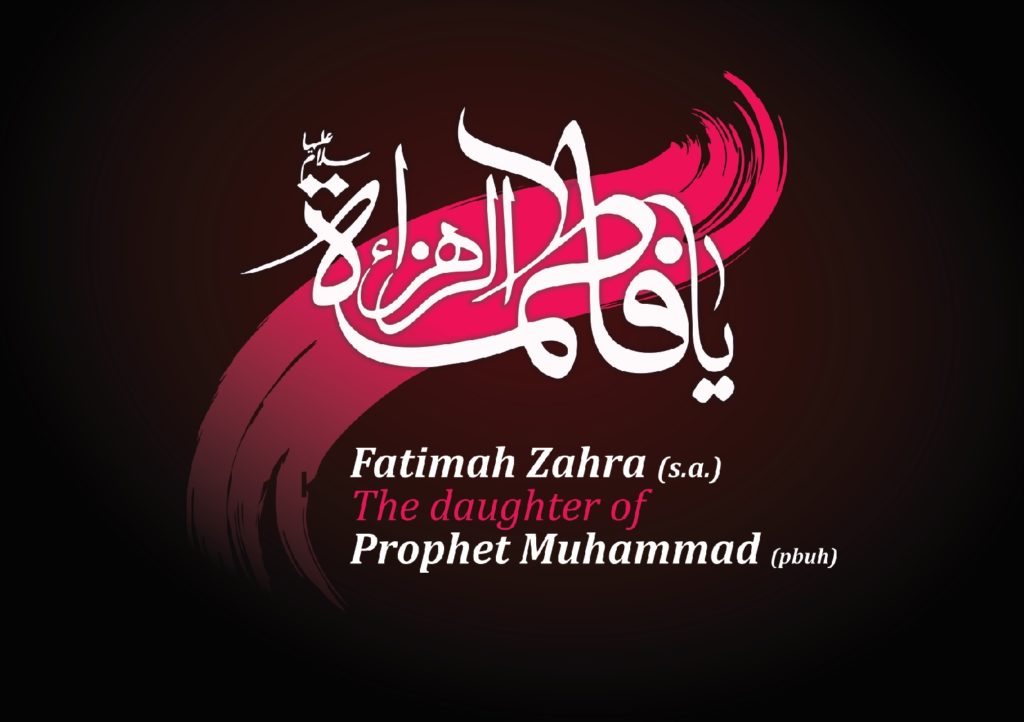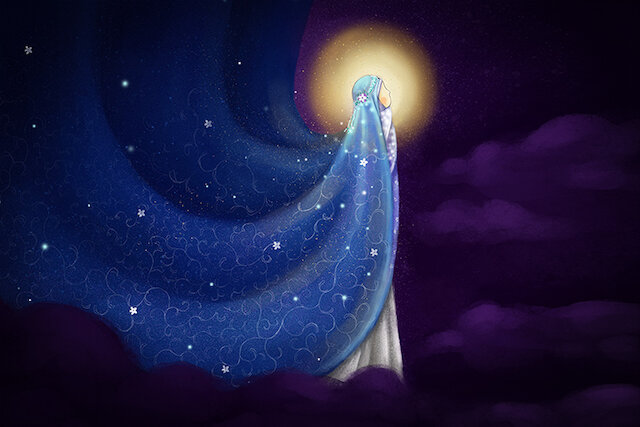
The Holy Prophet (S.A.W.): Fatema (S.A.) is a part of me
The Holy Prophet (S.A.W.): Fatema (S.A.) is a part of me: “What Allah gave to His Prophet from them (and), you did not spur any horse for its sake (acquisition), nor any riding camel; but Allah makes His prophets prevail over whomever He wishes, and Allah has power over all things.”
“What Allah gave to His Prophet from the people of the townships, are for Allah and the Prophet, the relatives [Ahl al-Bayt] and the orphans, the needy and the traveller, so that they (these properties) do not circulate among the rich among you. Take whatever the Prophet gives you, and relinquish whatever he forbids you, and be wary of Allah. Indeed Allah is severe in retribution. (Holy Qur’an 59:6-7)
The above ayahs clearly indicates what God has exclusively bestowed of worldly property on His Last and Greatest Messenger, saying in unambiguous words that since Muslims did not toil for its acquisition, they cannot claim any jurisdiction over this divine gift as public or state property.
According to exegetes of the holy Qur’an, these ayahs also refer to the vast tract of Fadak, its orchards, and its springs – about a hundred kilometers north of Medina – which its owners had gifted to Prophet Muhammad (SAWA).
They point out that the Almighty has explicitly forbidden not only the rich, the influential, and the politically powerful elements of the ummah from taking control of these exclusive possessions of the Prophet, but also makes it clear that those entitled to exercise authority over these divine gifts after Prophet Muhammad (SAWA) are his Immaculate Ahl al-Bayt – who scrupulously adhered to the practice of their ancestor by spending the yield of these lands for the benefit of the orphans, the needy, and the travellers.
Perhaps, the naïve amongst the Muslims, misled by a spurious hadith which alleges that prophets do not leave any inheritance and whatever worldly possession they leave behind becomes the property of the nation (contrary to the contents of the holy Qur’an which speak of Prophet Solomon inheriting Prophet David and Prophet Zacharias praying to God for an heir [Prophet Yahya] to inherit him), might ask whether or not Prophet Muhammad (SAWA) took any concrete steps regarding such exclusive God-given gifts, so as to prevent them from falling into the hands of the regimes that continue to rise and fall in the Arabian Peninsula after him.
Here, ayah 26 of Surah al-Isra comes to our rescue, with its clear wordings, as explained by the Prophet’s 8th Infallible Successor, Imam Reza (AS), during one of his debates with the Abbasid caliph, Mamoun: “Give to the relatives their (due) right…”
The Imam says that on revelation of this ayah, Prophet Muhammad (SAWA) called his daughter Fatema (SA) and said to her: “Fadak is one of the territories for which we did not exhaust our horses and camels to acquire it; it is mine exclusively. Now, I gift it to you and your offspring, according to God’s instructions.” (refer to books of hadith written by both Sunnis and Shi’ites over a millennium and a century ago, including Tuhaf al-Uqoul, Oyoun Akhbar ar-Reza, etc.)
The Islamic texts, both of hadith and history, including Tabari’s monumental chronicle, state that Mamoun returned Fadak to the Prophet’s progeny (only to be seized again by the next caliph).
The questions that arise are: How, in the first place, Fadak had fallen into the hands of the caliphs? Were the Abbasids the first dynasty to seize it, or were it the Omayyads, in gross violation of commandments of God and the Prophet’s bequeathal to his daughter and her offspring?
The sad answer – found in all authoritative books of our Sunni brethren – is that Fadak was seized from the bereaved Fatema (SA) herself, no sooner did her noble father breathe his last, and the caretakers appointed by her to supervise the distribution of its yield for the orphans, the needy and travellers were rudely expelled.
The usurpers of her patrimony were the ringleaders of the scandalous event of Saqifa Bani Sa’da, who also seized from her husband, Imam Ali (AS), his political right of caliphate, even though the Prophet had proclaimed him as his heir at the memorable gathering of Ghadeer-Khom on 18th Zilhijja, as per the express revelation of ayah 67 of Surah al-Ma’edah, while returning from the Farewell Hajj Pilgrimage, exactly two months and ten days before leaving the mortal world.
It is an irony of Islamic history and the real cause of discord that we see among Muslims today, the clique in Medina, not content with the seizure of Fadak and the hijacking of the caliphate – despite the fact that it was the wealth of Fatema’s (SA) mother Khadija (SA) which for years had saved them from hunger and possible death – insolently stormed the threshold of the Prophet’s daughter with fire and crowbars.
These fiendish rogues smashed upon Fatema (AS) the very door at which the Prophet used to salute her; breaking her ribs, making her suffer miscarriage (the stillborn Mohsin, becoming the First Martyr of the Ahl al-Bayt), and finally resulting in her martyrdom on the 3rd of Jamadi al-Awwal, a mere 95 days after the Prophet’s passing away.
No need to name the perpetrators of this grave tragedy in this brief column, since all early Islamic texts refer to each and every one of them by their names. These books also state that when the two chief culprits of this heartrending event, feigned remorse and approached the Prophet’s daughter on her deathbed, she reluctantly allowed them to enter her house on the insistence of her magnanimous husband, but refused to see their accursed faces. She then willed to Imam Ali (AS) to bury her in the dead of night at a secret spot, so that her killers will not be able to participate in her funeral.
In other words, Fatema (AS), whose eloquent sermon regarding the rights of her husband stands out as open testimony of divine wrath on the system of caliphate that did irreparable harm to Islam and to Muslim unity, left the world displeased with them, true to the Prophet’s famous hadith: “Fatema is a part of me; whoever hurts her has hurt me, and whoever hurts me, has indeed displeased God.”
Holy Prophet Muhammad (SAWA), the best example for humanity to follow